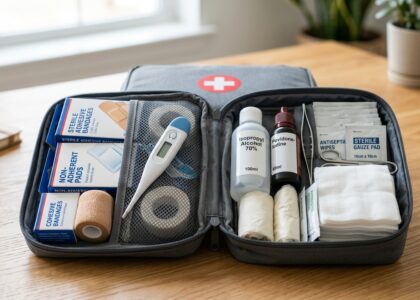


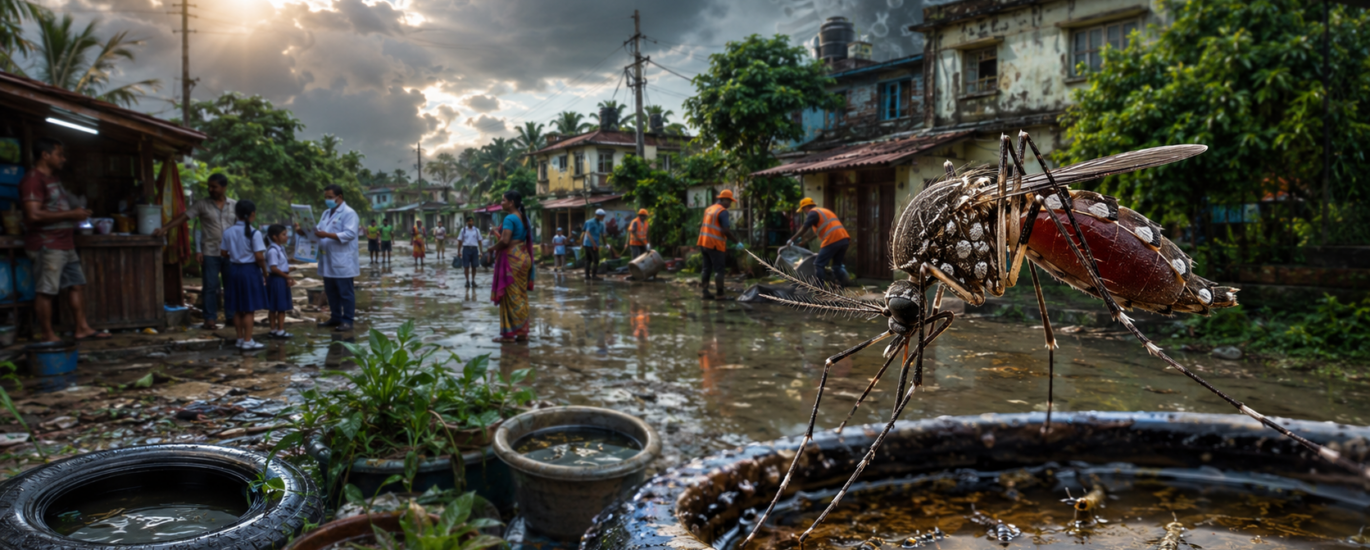
(Featured image generated by AI for illustrative purposes)
Dengue Season Is Back in Hooghly — Here’s What Every Household Should Actually Know
Every year around this time, the same pattern repeats itself. The first heavy spells of monsoon rain arrive, water collects in places nobody thinks to check—a cracked flower pot, a discarded tyre, the lid of an unused drum—and within a couple of weeks, the local health centre starts seeing more fever cases than usual. This year is no exception. West Bengal’s health department confirmed a fresh spike in dengue cases in the final week of July: around 500 new cases across the state in that single week alone, with Hooghly district contributing 50 of them — enough to put it among the five worst-affected districts that week, just behind Malda’s 53. That’s not a distant statistic from a news bulletin—it’s the district Tarakeswar sits in.
None of this is new, exactly. Researchers at the ICMR-National Institute of Cholera and Enteric Diseases who studied dengue trends in West Bengal over 2015–2019 confirmed that the state is dengue-endemic, with all four dengue virus serotypes circulating, and that cases consistently peak during the monsoon and post-monsoon months. So the question for most families isn’t “will there be a dengue season this year” — there always is — but whether you’ll recognise it early enough to matter.
What Dengue Actually Does to the Body
Dengue is a viral infection spread by the bite of an infected Aedes mosquito—the kind that’s most active in the early morning and just before dusk, and that breeds specifically in small pockets of clean, stagnant water rather than drains or ponds. The illness should be suspected when a high fever, around 104°F, is accompanied by at least two of the following: a severe headache, pain behind the eyes, muscle and joint pain, nausea, vomiting, swollen glands, or a skin rash. Most people who catch dengue never even realize it—roughly 80 percent of infections cause no symptoms or only a mild, uncomplicated fever—but a small share of cases turn serious, and that’s the part worth taking seriously.
Symptoms typically show up around four to ten days after the mosquito bite, and the fever itself usually settles within a week. The danger period, when it exists, tends to arrive right as the fever seems to be breaking — which is exactly when people relax and stop paying attention.
The Warning Signs That Mean “Go to a Doctor Now”
Global health guidance is fairly consistent on this point, and it’s worth keeping somewhere visible in the house during monsoon months. Contact a doctor immediately if someone with fever develops:
- Severe abdominal pain or persistent vomiting
- Bleeding from the nose or gums, or blood in vomit or stool
- Rapid breathing or visible fatigue/restlessness
- A sudden drop in body temperature combined with weakness or clammy skin
These “warning signs” generally appear three to seven days after the fever starts, often right as the temperature is dropping — which is precisely why the World Health Organization stresses that sound case management in hospitals has helped bring case-fatality rates down to under 1 percent in most affected countries. The outcome mostly comes down to how quickly someone gets seen, not luck.
Home Care: What Helps, and What Can Make Things Worse
For the majority of mild cases, treatment is supportive rather than a specific cure. There’s currently no dedicated medication for dengue—the standard advice is rest, plenty of fluids, and acetaminophen (paracetamol) to manage fever and pain.
The part people get wrong most often is the choice of painkiller. Ibuprofen and aspirin should specifically be avoided, because they increase bleeding risk in a disease that already affects platelets and clotting. Sticking to paracetamol, keeping the person hydrated with oral rehydration solution or coconut water, and monitoring temperature every few hours is the safest home routine — combined with actually watching for the warning signs above rather than assuming a dropping fever means recovery.
If you’re unsure whether a symptom crosses the line from “manage it at home” to “get it checked,” it genuinely doesn’t hurt to walk into your own local medical shop, Hayat Pharmacy in Tarakeswar, Hooghly, and ask. A quick word with the pharmacist about what to watch for, or picking up a reliable digital thermometer and ORS sachets before you actually need them at 2 a.m., tends to save a lot of panic later.
Why Hooghly’s Monsoon Is Particularly Favourable to Aedes Mosquitoes
The pattern isn’t random. Dengue cases in West Bengal have historically peaked in the post-monsoon window of October, easing off with the arrival of winter, in line with similar observations elsewhere in India—but the mosquito population that causes the October peak is already building up right now, through July and August, in exactly the kind of small water pockets that monsoon rain creates around homes, courtyards, and half-covered rooftops.
The same ICMR-NICED study found young adults aged 21–30 to be the most commonly affected age group, followed by adolescents aged 11–20—likely, the researchers noted, because of daily routines that bring this age group into more contact with the mosquito’s habitats. In practical terms: it’s not just young children and the elderly who need protecting. Working adults and students are squarely in the highest-risk group too.
A Realistic Prevention Checklist for Tarakeswar Households
None of this requires expensive intervention — mosquito control is almost entirely about denying breeding sites:
- Empty and scrub, don’t just tip out. Water tanks, buckets, coolers, and flowerpot trays should be emptied and physically scrubbed weekly — dengue mosquito eggs can survive on damp surfaces for months and hatch the moment water returns.
- Cover what you store. Any container storing water for more than a day or two needs a tight lid or fine mesh cover.
- Check the usual blind spots. Discarded tyres, coconut shells, broken tiles, and the tray under the fridge or AC unit are classic overlooked breeding spots during Bengal’s monsoon.
- Dress for the early morning and dusk hours. Aedes mosquitoes are day-biters, most active around sunrise and before sunset — long sleeves and repellent matter more at those specific times than at night.
- Keep a mosquito repellent and a net or vaporiser on hand, particularly for infants and anyone recovering from a recent illness.
- Report unusually high fever clusters in your neighbourhood to the local health worker—West Bengal’s monitoring depends heavily on that kind of local reporting.
Frequently Asked Questions
Is dengue contagious from person to person? No. Dengue only spreads through mosquito bites—a person cannot catch it directly from another patient. A mosquito that bites an infected person can, however, go on to infect others.
How long does dengue fever usually last? Symptoms typically last two to seven days. Most people recover fully within one to two weeks, though fatigue can linger a bit longer.
Can I take a fever-reducing tablet other than paracetamol? Stick to paracetamol (acetaminophen) only. Ibuprofen, aspirin, and other NSAIDs raise bleeding risk and are specifically discouraged in suspected dengue cases.
Should I get a platelet count test even with mild symptoms? If fever crosses two to three days and doesn’t respond to paracetamol, it’s worth getting a blood test done rather than waiting it out—platelet trends are one of the clearer signals doctors use to judge severity.
Where can I get a reliable thermometer, ORS, or advice quickly in Tarakeswar? Hayat Pharmacy in Tarakeswar, Hooghly stocks thermometers, ORS, paracetamol, and mosquito repellents, and the staff can point you toward the nearest clinic or diagnostic centre if a case looks like it needs medical attention beyond home care.
The Bottom Line
Dengue isn’t new to this part of West Bengal, and it isn’t going away this season either — the district numbers from late July confirm that much. What actually changes outcomes is ordinary vigilance: clearing standing water before the mosquitoes find it, recognising the warning signs instead of waiting them out, and knowing exactly what’s in the house — and what’s a short walk away at your local medical shop — before a fever turns into an emergency at midnight.
This article is for general awareness and does not replace professional medical advice. If you or a family member shows any dengue warning signs, consult a doctor immediately.
Sources
- World Health Organization — Dengue and severe dengue, fact sheet (who.int)
- ICMR-National Institute of Cholera and Enteric Diseases — “Geographic information system-aided evaluation of epidemiological trends of dengue serotypes in West Bengal, India,” PMC
- Business Standard — “Dengue cases rising in West Bengal, govt says situation under control,” district-wise case data
- Centers for Disease Control and Prevention (CDC) — Dengue: symptoms, spread, and prevention
- Africa Health Organization—Dengue and severe dengue fact sheet (diagnostic criteria)